
DevCon is a large Open Technology event, intended for groups and companies to showcase privacy, security and open technology products and services. This year, the 8th annual show took place in India, for the first time. Thanks to a long standing association with Maker’s Asylum, an open workshop group that used to operate from Mumbai, but is now in Goa, Navodaya was able to present the Chalopede concept, the engineering, design and roadmap, to an international audience of hardware focused technology experts.
The Chalopede is the name coined for a class of vehicles, ranging from small human powered people carriers to large utility vehicles, that move on legs and not wheels, the common choice. To understand why this seems to be a sensible option for a project that will, as shall become clear in the paragraphs below, involve large numbers of people conceptualising, designing, building and using for themselves, a look back at vehicles through the ages is a good idea.
It is possible that the necessity to ease the task of carrying people and goods was recognised, and acted upon, before the development of civilisation, but we have not found, so far, any evidence, no artefacts and no images engraved on durable materials, such as rock carvings, prior to the excavation of old towns or cities from the early Sumerian period, probably about seven thousand years ago.
We can only conjecture that it began much earlier, that the movement of people across large distances, as DNA analysis of very ancient human remains informs, was aided by employing animals to carry loads, and then to drag them, probably on sleds made from logs of wood bonded together. We know this is very possible, because we have physical evidence that the discovery of thread, an essential step to making rope, was made far earlier.
Sleds, however, must withstand heavy wear and tear, and at some point, the idea of using rollers might have evolved, naturally, towards using wheels. This is actually quite a smart move, and it involved a good understanding of what makes a wheel better than a sled, for this purpose. A wheel needs an axle, and it needs a hub, placed accurately at the centre, to allow it to rotate around the hub without both getting worn out quickly. We also know, from excavations of the building architecture from this early civilisation, that the working of materials like stone was also quite sophisticated, and it very likely involved understanding rolling motion.
Did they consider making legs instead of wheels, given that, all around them, was plentiful evidence of legs and leg mechanisms evolved in nature, and almost no evidence of wheels? We don’t know, because we have no evidence, no artefacts and no written or drawn clues to such an idea.
We do know that from the idea of goods bearing vehicles came the development of handy people movers, chariots, simple two wheeled carts that could move relatively fast, when pulled by one or more nimble animals like a horse. Horses and bullocks were reasonably abundant, and not difficult to train for the purpose.
What took more time to develop though, and has had far more consequence through the ages, was the idea of specially prepared roads, that make travel faster, and make it more practical for a civilisation to consist of many dwelling places connected and working together, over larger tracts of land.
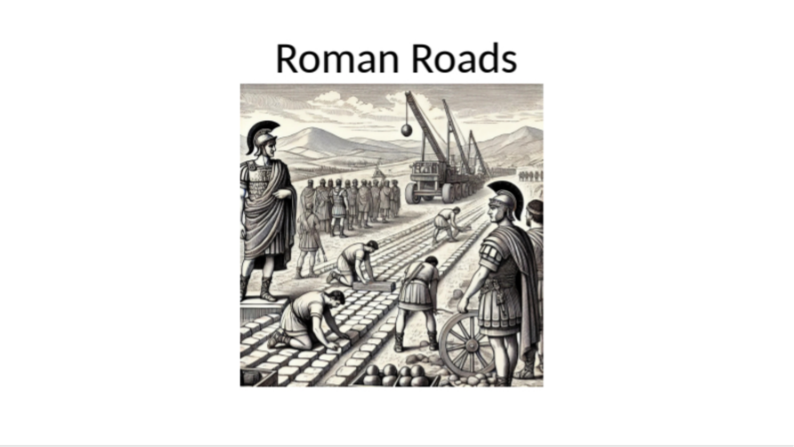
The Roman Empire is credited with this development, with the construction of a paved stone road (the Appian Way) that is still in use, after over two thousand years. There are other roads that are older, such as stretches of the Silk Route that crosses from what is now Europe to Asia, but they were not paved until much later, instead, being regularly repaired and reconstructed.
In the modern world, the construction of paved roads, often called metalled roads, is the norm.
We know, from extensive histories written by Roman contemporaries, that the first durable roads were constructed as part of an innovative military strategy, rather than an aid to commerce or for the comfort of long distance travellers.

Large ballistic weapons, that could toss either heavy projectiles or large bundles of burning materials a long distance, had become part of the standard arsenal of warriors and armies of the time, and the Roman Empire was at the forefront of employing such weapons on the battlefield. However, it was virtually impossible to move such weapons to remote battlefields, instead, they were dismantled and then assembled again on site. This could take months, during which time the enemy could, if sufficiently well organised, attack the Roman camps and cause havoc.
The innovation discovered by the Romans was to design the weapons to be mounted on carriages, which could be moved much faster to a battlefield, and this gave their armies an extraordinary tactical advantage.
One need not imagine that the pace of civilisation was one of endless wars, but this was a period when military conquest was used to drive trade and commerce between far flung peoples. The natural wealth, agriculture and mining, of Europe became an engine to pump the Roman civilisation to make trade connections across large parts of the known world, eastward to India and beyond. It opened Roman artisans to the complex achievements of other civilisations, and in turn they amplified their own skills.
Roads are not, so much, an unmixed blessing. While they enable high speed transport on wheels, both paved roads and steel rails, this comes at a cost that the world is only beginning to recognise, much less come to grips.
One very large issue is the cost. Modern cities have roads that are paid for as a common burden, whether or not the citizenry actually use them. In fact, in cities with high speed mass transit services, a paved road has very little purpose for most people. One might argue that the current high speed mass transit systems themselves use hardened roads (steel rails inside giant concrete tubes, for instance, or mounted on overhead pillars that are also rooted in the ground), so the benefit comes to larger numbers of city dwellers, but this too, only extends to the city limits. Beyond that, the roads (and railways) are a huge disruptor of natural flows, both of land and water.
The modern ecological sensitivity movement is itself a product of vastly expanded sensitivity to the fragility of the overall environment of the world in which we live. This fragility is, of course, only of relevance to the continuing wellbeing of the people who live here, but this makes an unpleasant amount of sense when the fact sinks in that there’s nowhere else to live.
The people who study science, and who advise those who are appointed or elected to make the decisions that govern the living conditions of people, are coming to grips with the fact that making changes to the natural flow of lands and water has consequences that sometimes take generations (ie multiple lifespans of humans) to accumulate multiple impacts that, if left to chance, can become extremely threatening.
The other negative side of this focus, on having a few people authorised to make collective decisions, is that it becomes very difficult to make course corrections. This is particularly true when the current technology is not questioned, when the very expression, Reinventing The Wheel, is a pejorative, as though such reinvention is harmful to the future progress of the species.
Given this situation, let’s take a look at the mechanics of tampering with it, the future progress of our species.
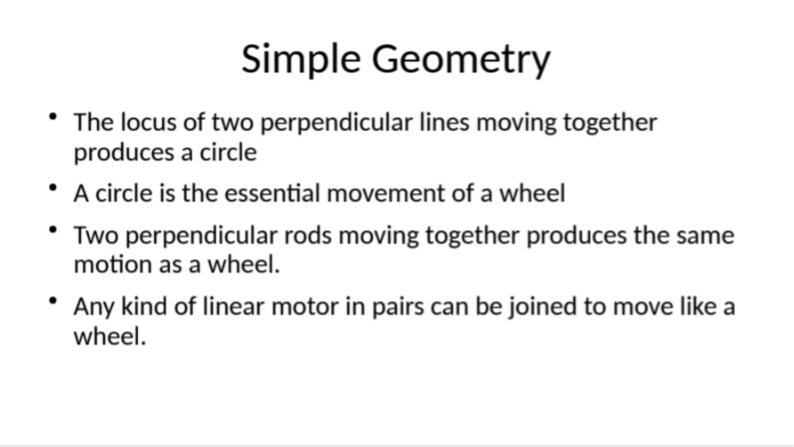
The mathematical knowledge of the Greeks, already codified, was used to create great engineering works, such as the Roman aqueducts, long channels that bridged valleys and tunneled through hills. Yet, somehow, they missed one fairly down to earth device, an application of two simple rods moving together. When this motion is at right angles, oscillating about the centre of the two rods of equal length, moving at the same velocity, the resultant line describes a circle. This circle is, in fact, mathematically the same as a wheel, but the connection was not drawn, in any great or remarkable fashion, for another two millennia.
During that time, the fallback notion of carts needing wheels became ingrained, and this in turn meant that the early paved roads, meant to ensure victory in battle, became the default for helping wheeled carts become more comfortable for their passengers, apart from extending the life of the carts, that might otherwise suffer extensive wear and tear on rough roads.
In the waning years of the twentieth century of the Common Era, an artist named Theo Jansen began building, innovatively, very large works of mobile art. His big machines, built of lightweight materials, were autonomous movers, crossing the soft sands of the beaches of Holland on legs that use that simple geometrical reality.
He added an insight, that the motion is the objective, not the description of a circle. With greater efficiency, his movers spend greater parts of the cycle on the ground, lifting up swiftly and returning rapidly to the start point in the last quadrant.
A machine with multiple legs, even though each one is relatively lightweight and fragile, is tough enough to handle eccentric loads like mobile sails, that angle to catch enough breeze to supply energy to move the vehicle. Since they move on sand, and are large, like many of the dinosaurs of the previous epoch, he calls his designs Strandbeests.
The Strandbeests have been evolving every year, as he tests and builds new structures, drawing on energy from wind and water, mostly the former, to move independently about the beaches.
In short, he has been patiently and doggedly building proof of concept moving vehicles, using them to exhibit his art, for decades.
Chalopede is a project to take such proven designs and use them to benefit society in other material ways.
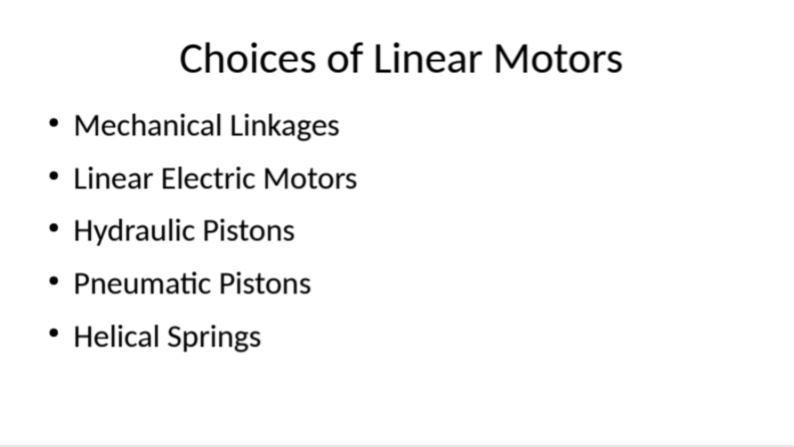
The starting point is moving elements that travel in straight lines. The simplest of these are pure mechanical linkages, that were codified a century and a half ago in a wonderful illustrated book, AB Kempe’s collection of linkages. Most of these mechanical assemblies do some pretty amazing stuff, that can be found in hundreds of machines that underpin modern industrial society. A few of them do the really simple thing, in several different ways: they take a mechanical force and use it to move an actuator in a perfectly straight line.
However, we also have other ways of doing this, machines that, deceptively simply, take a force, derived from some source of energy, and create a straight line motion.
These are probably quite well known, and recognisable to a wide audience: linear electric motors, hydraulic pistons, pneumatic pistons and helical springs, the last of which actually locally store the delivered energy right there, in the material of the moving element.
Any pair of such elements, set to move in perfectly perpendicular pairs, will produce a perfect circle, as the pairs oscillate through equal distances.
What Jansen does with his Strandbeests is to fix that equality, so that the vertical moving element of the pair of motions is not moving equal to the other, which is, in fact, applied common sense. The lowest point of the motion is held steady through (roughly) three quarters of the cycle, then, in the last quarter, it moves quickly back to the starting point.
When this motion is combined with three other such mechanisms, it produces a smooth, and wide, force applied to the ground, to hold the rest of the machine level, no matter whether the ground surface is perfectly level, or smooth, or not.
This is also, as it happens, what a pneumatic tyre does, for a bicycle or a car, taking advantage of the elastic property inherent to rubber and alternate synthetic substitutes commonly used. That wide footprint delivers a sensation of comfort through the actual dampening of ground surface roughness, into the vehicle, for both the passengers and for numerous other mechanical and electrical mechanisms, that might get worn out with excessive jolting.
This is what any kind of passenger, load bearing, or utility vehicle that is intended to move on natural surfaces, ground that has not been necessarily smoothened and hardened to carry point loads without deforming, needs.
Any set of four (and possibly just 3, but this needs to be tried out in a full size working model) actuators working in tandem will deliver a sensation of smooth travel, to a passenger or driver. Obviously, there are limits, in that an excessively large obstruction, such as a big rock, will present an obstacle, which is what a person walking already knows, and moves around, rather than trying to clamber over.
The Chalopede innovation lies on two platforms, one is obviously the mechanical design, and the other is the method of organising detailed design, development and construction.
The second part is intended to be as much collaborative, and more, than the approach used to conceptualise the core design. This took place in the Homi Bhabha Centre for Science Education, an institution that is part of the Tata Institute of Fundamental Research, one of India’s premier knowledge groups. It is a collaborative effort, collecting published research and discussing the alternatives possible and worthy of taking forward to construction.
The second part, actually designing and constructing one or more working machines, is to take place in a more challenging environment, learning centres aimed at raising science consciousness and design sense founded on research and original thought.
While there already are a few such learning centres, mostly in cities, this project will move forward with the creation of one or more Chalopedes based on the thinking and contributions of young people who are accustomed to accomplishment with economy, using scarce resources, and doing more with less.
Once a few working pieces are ready, they will be used to assist the creation of more learning centres, equipped with workshop level machine tools and, possibly, digital tools to speed up hypothetical design or proof of concept.
Rural workshops of this nature will be used to further the idea of very local design, sale and service, in order to develop multiple kind of vehicles that individually serve very local needs, and that are built for and maintained locally, to fulfill specific niche purposes. Agriculture is an obvious area of focus, but it is just one of many functional areas that can support very local, ‘hyperlocal’, industry.
The above links are to the discussion areas where the Chalopede concept was discussed online over the years, as well as to the area where the need for such developmental activities was considered, in the context of a holistic approach to a widely distributed and owned industrial base intended to support a more sustainable economic order.